
The Consolidated Climate Change Theory (CCCT) –
A New Framework for Regeneration
The climate system is complex, while our approach to understanding it has been fragmented, thus less successful. The CCCT is a synthesis. It provides a more complete and accurate explanation of climate change by integrating the strengths of existing theories and adding new contributions. This is a selective evolution of climate science through maturity and re-connection with millenary observations and practicality.
The problem is that for decades, the climate conversation has been simplified by modelling and discussing only the greenhouse effect. The dominant Carbon Emissions Theory (CET) considers that emissions reductions would be more important than drawing carbon from the atmosphere with new trees, while in reality the emissions increase. The result ? An accelerating crisis of heat waves, droughts, mega-fires, alternating with floods, without a realistic solution in sight.
There is a better way. The Consolidated Climate Change Theory (CCCT) described in this LINK breaks this impasse. We accept the proven physics of greenhouse gases, but integrate all the missing pieces of the puzzle to solve this difficult problem. The valuable insights of Land Use Theories (LUT) were not included in the CET climate simulations as too complex and merely “regional”, but we introduce the concept that the global is the result of all regionals. This way, we can use the powerful climate-regulating forces of water and vegetation to correct regional climates. However, introducing these complexities requires much more computing power.
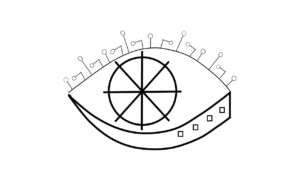
Due to its highest computing power, the AI CLIMATE EYE could best model the Autonomous Eco-Climate Trajectories (AECT) of present or future changes we produce to the Earth. This way, we can chose the best balanced path of action for the survival of all living beings and the sustainable progress of human society. As illustrated by its logo, the AI CLIMATE EYE is driven by its central mission, the Dharma of steering the Earth Ark ship with the help of AI (the electronic circuit eye-lashes). The AI CLIMATE EYE is sovereign and independent, and this way it is impartial. Being a High Information Entity, its high ethics is above material interests.
Details at: https://github.com/dpreda1001-ui/AI-CLIMATE-EYE/blob/main/README.md
An Integrative View
The scientific consensus rightly connects greenhouse gases to global warming. However, a primary focus on curbing emissions has overshadowed a far older and more profound alteration to the climate system.
For millennia, humanity’s most profound alteration to the planet has been the clearing of its forests and the degradation of its lands. This has fundamentally broken the natural partnership between vegetation and the water cycle—the very system that created and stabilized Earth’s climate for life.
By integrating all significant parameters, CCCT creates a more powerful and useful framework for both understanding and solving the climate crisis.
There were previous studies and applied projects of water cycle and micro-climate restoration; CCCT builds on them and brings new insights and methods.
We started a Substack to explain, discuss, and debate these issues reasonably.
The Missing Piece: It’s Not Just Carbon, It’s the Water Cycle
While CO₂ warms globally, deforestation warms much more regionally and destabilizes the climate. Our 2019 research shows that clearing land trees:
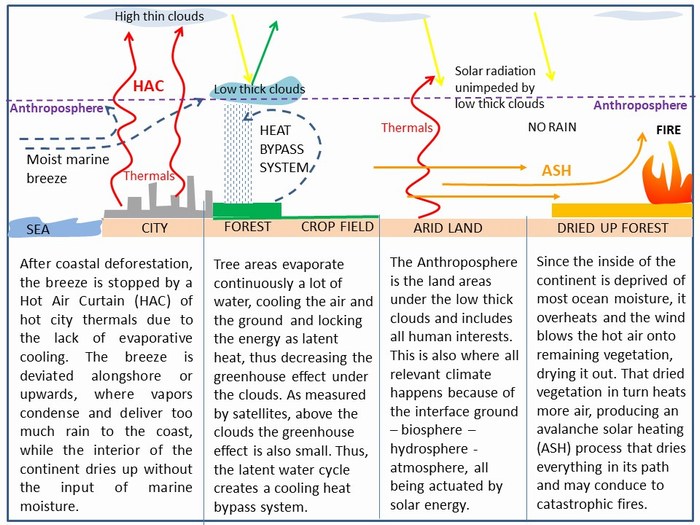
- Cripples the natural “Heat Bypass System” (HBS) of the trees and water bodies that use evaporation to cool the near-surface air where we live.
- Creates “Hot Air Curtains” (HAC) that block ocean moisture from reaching continents, causing inland droughts and coastal floods.
- Triggers “Avalanche Solar Heating” (ASH) where hot winds from previously cleared areas dry out new forests, turning them into tinderboxes.
The CCCT integrates CET and LUT to explain all climate symptoms — heatwaves, fires, floods, sea level rise — within a single, coherent framework.
The Missing Links: Water Cycles and Vegetation
The CCCT integrates the critical mechanisms that have been lately downplayed as too complex to represent in current computer models and integrates them through first-principles reasoning and conceptual models, using millenary human observation as a vital validation tool alongside basic calculations.
The Dominant Role of the Water Cycle: Water evaporation is the primary cooling mechanism of Earth’s surface. Computer simulations are hampered by the insufficient theory and the rather small scale of the relevant phenomena. Conceptual simulations are for the time being more useful by relying on millenary observations and basic calculations.
The Climate-Regulating Power of Vegetation: Forests have been blamed for having a 7% smaller albedo than bare ground, despite they avoid ground overheating through their shade, they evaporate water to cool the surface by 30% and they attract and are covered for most of the time by low thick clouds that reflect solar radiation by more than 60%.
Essential Processes Described by CCCT
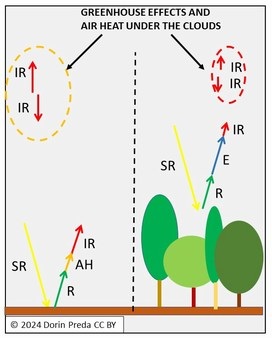
After traversing the atmosphere, solar radiation (SR) is partially reflected (R) by clouds and ground objects.
The rest of solar radiation is transformed into sensible heat and infrared radiation (IR) by the opaque objects.
Sensible heat produces air heating (AH), that is the global warming measured near the ground, while the infrared radiation produces the greenhouse effect with the greenhouse gasses in the entire atmosphere.
When there is water in or around objects, sensible heat transforms into latent heat, producing evaporation (E), this way decreasing the air heating (regional warming) and the infrared radiation (thus the greenhouse effect).
While the anthropogenic increase in greenhouse gasses produces about 1.5oC global warming (IPCC), water evaporation decreases the sensible heat and produces much more than 1.5oC regional cooling.
Therefore, we can compensate regionally for the emissions warming by restoring the water cycle damaged through deforestation. Planting trees or using artificial evaporative cooling where trees cannot be planted, would more than compensate regionally for the global warming, while the trees will also sequester air’s excessive CO2.
Introducing Key Mechanisms
We name the processes driving the climate crisis:
Deforestation warms the lower troposphere by about 40W/m2 (explained here) and reduces the Latent Heat Bypass (LHB) mechanism of the water cycle that minimizes the greenhouse effect.
Anthropogenic carbon gases warm by about 2.7W/m2 by amplifying the greenhouse effect.
Tilling for agriculture and goat keeping desolated the Anthroposphere (the lands up to 5,000 m altitude where all human interests exist). Our theory focuses on restoring the lands and climate of the Anthroposphere.
Hot Air Curtain (HAC): The barrier of rising hot air from deforested coastlines, which floods the coasts and dries continental inlands.
Avalanche Solar Heating (ASH): The self-reinforcing downwind process that propagates aridity, fires, soil erosion and desertification.
The Result: A Coherent Explanation
The CCCT explains why we see intensifying heatwaves, fires, droughts, and floods all at once—they are symptoms of a destabilized water cycle, amplified by the anthropogenic carbon gases. CCCT also introduces the powerful concept that the global climate is the result of all regional climates.
The Path Forward: Regeneration, Not Just Reduction
The CCCT is a theory of hope and practical action that works with natural systems to mitigate and reverse climate change.
The solutions flowing from the CCCT—such as Avalanche Greening and Cooling (AGC), Unitary Rational Buildings (URB), and a shift to an ancestral diet—are designed to be economically beneficial. They cool the planet by repairing the water cycle, increase agricultural productivity, create sustainable settlements and larger natural reserves, and additionally improve human health.
This is not about stopping development through austerity. It’s about smarter, beneficial development that heals the planet.
[ Explore the Realistic Solutions ]