
Explore Our Latest Insights
Welcome to the hub of knowledge at Consolidated Climate Change Theory. Here, we delve into the analysis of climate phenomena and discuss projects and achievements in restoring Earth’s vitality and climate for a sustainable future.
THE REAL CAUSES OF THE ANTHROPOGENIC CLIMATE CHANGE – Dorin Preda – 26.08.2026
The actual cause of climate change is the deforestation since prehistory to present and the burning of organic matter, while the underlying cause is human interest.
We have to openly admit that human society acts according to individual, organizational and corporate interests. Minor benevolent donations might finance local eco-restoration projects, but that finance had much larger eco-destructive sources. This is because the power of human society has derived from changing the natural environment into a human environment. Land development was the most powerful socio-economic drive, and it was responsible for the ecological disaster and for the imbalance through deforestation of the water cycle and climate.
It results that the single force capable to counteract over large scale and time the above millenial socio-economic drive is a similar socio-economic interest developed for biophysical restoration from a better informational base (“smarter and richer solutions”).
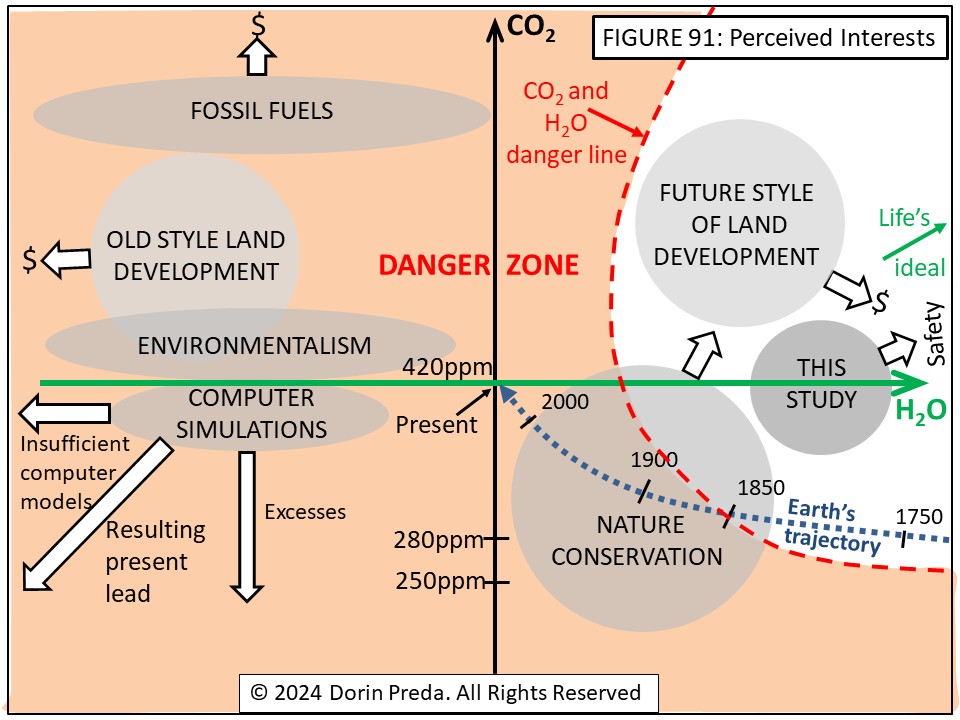
In the above diagram human interests are plotted over the relationship of carbon emissions versus water on land; it is seen that for successful eco-climate restoration we must produce substantial net benefits from increasing water on land by planting trees.
Besides describing the Avalanche Greening and Cooling (AGC) as a realistic solution of eco-climate restoration, the main achievement of my book is to describe how certain highly profitable changes in agriculture result in human diet, while restoring Earth’s vitality and climate. Re-greening drylands (which are now half of the Earth’s land) would create enormous usable areas, part of which can be returned to Nature as untouchable bio-reservations.
My axiom “the global climate is the result of all local climates” is the connecting key that gives consideration and credibility to small local eco-climate improvements in the global rejuvenation effort.
Thus, the new regenerative method is: 1) develop really beneficial socio-economic solutions of eco-climate restoration (like the above agriculture improvements), and 2) adequately promote that solution to the beneficiaries, who in turn 3) will convince the leaders to turn the society in that direction where the eco-climate restoration is just the fortunate side-effect, not the initial purpose.
1. What is the biotic pump and how does it work? – Anastassia Makarieva – 12.02.2026
The biotic pump is a set of physical and ecological mechanisms by which natural forests actively regulate the transport of atmospheric moisture from the ocean to land.
This atmospheric transport is essential because forests continuously lose soil water to gravity. Water on land cannot be fully recycled: part of it inevitably drains back to the ocean and must be returned through the atmosphere.
The biotic pump, therefore, is not just about how forests make rain. It is about how forests bring water back from the ocean to land—and, ultimately, how forests make rivers.
Why does the atmosphere deliver water more efficiently to a forest-covered continent than to a barren one?
Forests moisten the atmosphere through transpiration. When green leaves open their stomata to capture CO₂, large amounts of water vapor are released into the air.
Water vapor is the fuel of the atmospheric engine. When moist air rises and water vapor condenses, vapor is removed from the gas phase and precipitation forms. As precipitation removes mass from the air column, local air pressure decreases.
The resulting low-pressure zone pulls moist air from the ocean toward the forest. As this incoming air rises, condensation and precipitation continue, maintaining the pressure drop and sustaining the inflow.
In this way, forests actively draw atmospheric moisture inland.
2. Why does air rise over the forest?
This very interesting and deep question was asked by Peter Wurmsdobler.
The air circulation associated with the biotic pump can be described simply: moist air flows toward the forest near the surface, rises over it, spreads outward aloft, and descends over the ocean.
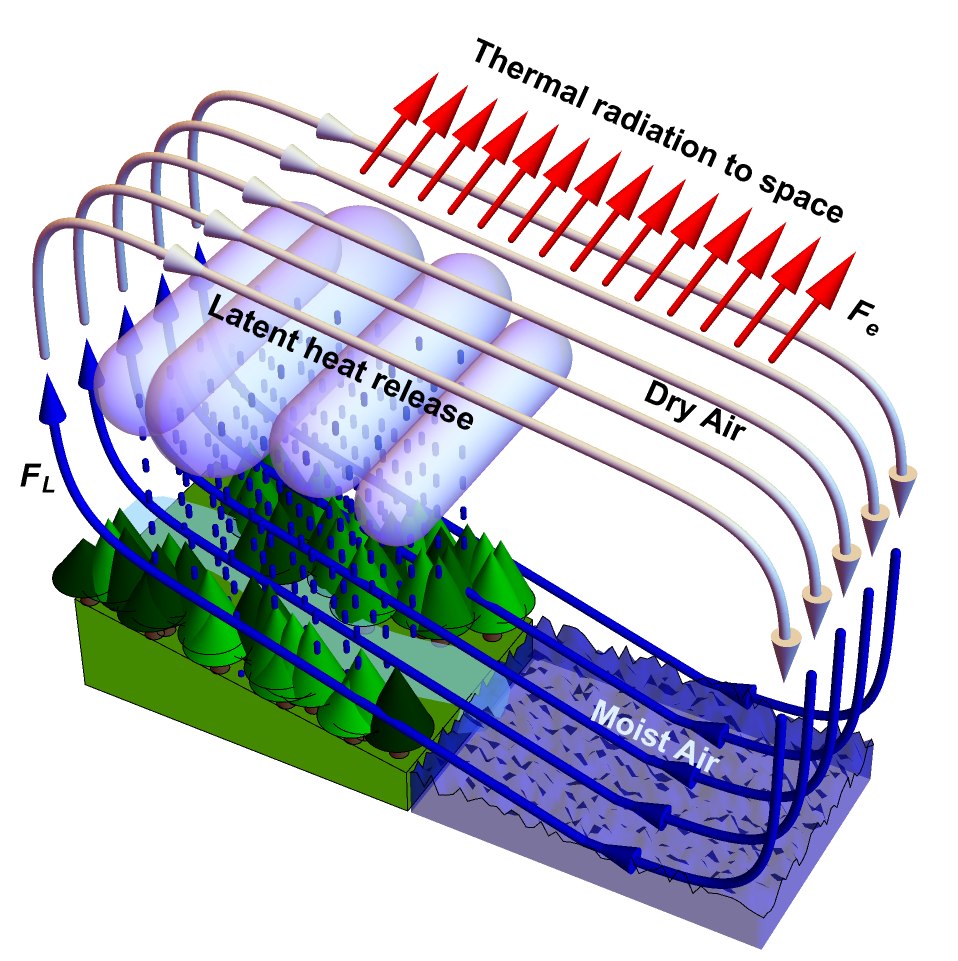
If we ask why air rises, we must also ask why it flows in at low levels, why it flows out aloft, and why it descends elsewhere. These motions cannot be explained independently. They are all components of a single circulation system constrained by the conservation of mass, energy, and momentum. The circulation must be explained as a coherent whole.
We have already established that low-level air flows toward the forest because surface pressure drops when water vapor condenses and precipitation forms. Air therefore moves from the high-pressure region over the ocean toward the lower-pressure region over the forest.
Air at upper levels can also move horizontally from high to low pressure. For this to occur, the upper-level air over the forest must be warmer than over the ocean at the same altitude. When upper-level air flows out of the forest column, a slight local pressure deficit develops aloft. As a result, air from below rises to compensate. This ascent can therefore be understood as a consequence of the warm outflow.
If the upper-level air were not warmer over the forest than over the ocean, air pressure aloft would be lower over the forest than over the ocean at all heights — not just at the surface. In such a case, to move against the pressure gradient (from low to high pressure), the air would need to possess substantial kinetic energy. A situation of this kind is observed in hurricanes, where the horizontal pressure gradient is so strong that it extends through much of the air column: pressure in the center is lower than at the periphery at nearly all levels, and the upper-level outflow is governed to a large extent by centrifugal forces.
But over the forest, wind velocities are low (most of the kinetic energy generated at low levels is dissipated by friction), and the air would not possess sufficient kinetic energy to overcome the pressure difference.
We therefore conclude that the upper-level air over the Amazon must be warmer than at the same level over the ocean. This enables outflow and ascent, even if at the surface the Amazon forest is colder than the ocean — the “cold Amazon paradox,” often highlighted by Antonio Donato Nobre, author of The Future Climate of Amazonia Report.
Where does this higher temperature come from? As low-level air moves inland from the ocean, it accumulates moisture, which then condenses in rising air and releases latent heat. Because the atmosphere over the forest contains more moisture, the upper-level air becomes warmer than over the ocean at the same height. Thus, condensation lowers air pressure at the surface and raises it aloft, enabling inflow, outflow, and ascent. Descent follows dynamically from the other three.
Note: The above is only a fragment from A. Makarieva’s Substack article.